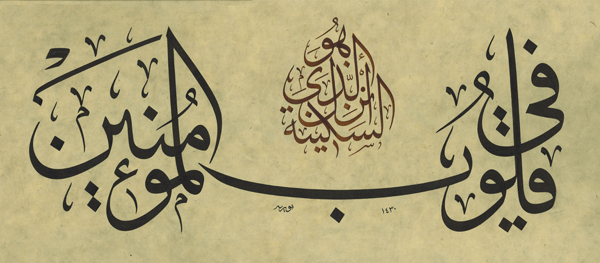
The seeker must journey from the Haʾ of the Name back to the Alif, bearing in mind their differing levels. Entering unto the singular Alif (al-alif al-fardani) is achieved through the attributes of the saint (wali), not through those of the believer (muʾmin). Attaching to the elevation (rifʿa) of the Alif enables the knower of God to taste the reality of servanthood.
In a sense, your wayfaring is like a circumambulation (ṭawaf) around the Alif. This Alif is not the Alif of the singular Name of God exactly, but represents the descent of the primordial Alif (al-alif al-asli) into the two Lams of the divine name, so that you may read it by virtue of the Haʾ. For the Lam is like an Alif that is curved at the bottom.
Moreover, the Alif of the divine name descends into every one of the ninety-nine Most Beautiful Names of God; it appears in the rest of the Names as a Hidden Alif, so that in this sense each Name has an opening onto the Essence, and an opening onto the Attributes.
Moreover, just as the Arabic letters join together, with the middle Lam of the Divine Name intertwining with the letters before and after it to make an unbroken line, you should thus be like a Lam, by virtue of the love and annihilation (fanaʾ) in the intermediary (wasiṭa), so that your shank intertwines with its, and its light, secrets and gnostic teachings flow through you the way they flow through the Lam.
— Shaykh Mohamed Faouzi al-Karkari (Taratil al-Ha'iyya)
Choose a Path for yourself. You can be an Adamic human being by virtue of the inblowing of the Spirit within you…or a bestial human being by virtue of the dominance of your bestial body, so that the Spirit’s influence weakens within you. You will then become ignorant of your reality, and you will not draw out the treasure that is buried within you.
The seeker must journey from the Haʾ of the Name back to the Alif, bearing in mind their differing levels. Entering unto the singular Alif is achieved through the attributes of the saint, not through those of the believer. Attaching to the elevation of the Alif enables the knower of God to taste the reality of servanthood.
When you strive against your lower self, the reality of this world becomes evident to you, you know that it is non-existent; that it has no existence except through God. Then God provides you with light, and through that light you come to know how close He is to you.
A mantle conceals the upper part, whereas a garment conceals the lower part. The higher part of the divine mantle is an allusion to Lordship (rububiyya). This mantle of Lordship comprises two sides: the outer side is the aspect of Lordship, and inner side is the pre-cosmic reality of the Cloud (al-ʿamaʾ).
the sensorial human being is the one whose heart is stamped by the forms of the sense-objects. He is marked by a dominant love for the herebelow. Moreover, the spiritual human being is the one whose inward vision (basira) has opened up so that he perceives what lies beyond the sensorial realm.
The Prophet (s) recommends fasting during these blessed days, and it is said that Ibrahim (s) fasted them as well. The early Arabs called these days the “White Days” (al-ayyam al-biḍ) because the moon is brightest during this period and it achieves its most complete perfection.
With manifold arguments and no shortage of nagging, my teachers, father, family, friends, and loved-ones, sought to hold me back from cutting my worldly ties and setting off alone in search of God and a true master; and in their efforts to do so they would attempt to clinch the matter with various rational and religious objections.
The spiritual traveler’s journey through the Name, however, must begin at the last letter Haʾ, which we call the Haʾ of Divine Identity (haʾ al-huwiyya).
Reflective thought that is devoid of the remembrance God (fikr duna dhikr) is a transgression. For true reflection only occurs in the wake of long periods of remembrance (dhikr tawil), once your time has been filled with the invocation.
And this is the dot that is ascribed to the all-inclusive names and divine realities because it is through the basmala that God takes charge over the servant who has realized the station of servanthood and upon whom His names and attributes have become manifest in both his knowledge and his state.